The DoubleHARD sawmill blade has been Wood-Mizer’s most popular blade for more than a decade.
It is affordable and dependable for all general sawing conditions. Higher quality steel is used, and the teeth are induction hardened. DoubleHARD blades are tough, non-brittle, and will not chip or wear prematurely. DoubleHARD blades offer unmatched cutting flexibility, whether you want to cut frozen or kiln-dried timber, softwoods, hardwoods or knotty woods.
Both large businesses and mobile sawyers alike depend on Wood-Mizer DoubleHARD blades for their sawing.
All available bandsaw blades:
| Material Type | Thickness x Width (mm) | Profile |
|---|---|---|
| Doublehard (BD/DHL) | 1.07 x 33 1.14 x 33 1.07 x 35 1.14 x 38 1.07 x 50 |
10/30 10/30, 07/47 10/30 10/30, 07/47 10/30, 07/47 |
Sawmill Blade Material Selection Guide

SilverTip Carbon Steel
SilverTip is an ideal blade for primary and secondary breakdown as well as for high volume sawing environments.
DoubleHard High-Alloy Steel
DoubleHard is a durable all-purpose blade for sawing softwoods, hardwoods, knotty woods, and frozen woods.
MaxFlex Premium Quality Steel
The specialized alloy used for the MaxFLEX sawmill blade provides longer blade flex life and increased durability.
BiMetal Two-Piece Steel
Bi-Metal offers a longer sawing sharp life than most carbon and high-alloy blades and is engineered for production sawing environments.
Sawmill Blade Thickness x Width Selection Guide
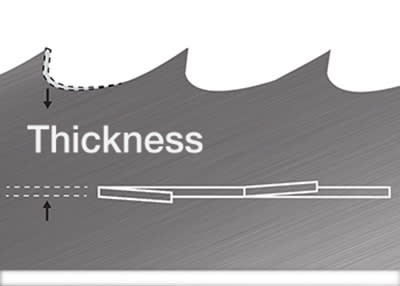
Thickness is the thickness of the body of the sawmill blade without including tooth set.
- Thicker blades (1.14mm, 1.27mm, 1.4mm) provide faster feed rates and better cutting performance in difficult sawing conditions such as knotty, frozen, dry or extremely hard material, but require higher horsepower (25HP or more).
- Thinner blades (0.90mm, 1mm, 1.07mm) provide longer flex life with lower horsepower (24HP or less) sawmills where production or speed is not a primary factor.
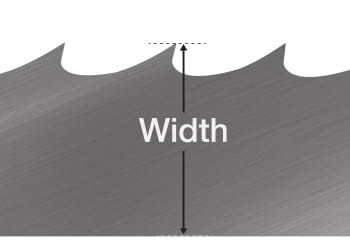
Width is the distance between the tip and base of the sawmill blade.
- Wider blades (38mm to 50mm) are for higher horsepower (25HP or more) sawmills and a faster feed rate.
- Narrow blades (25mm to 38mm) are for lower horsepower (24HP or less) sawmills and more difficult sawing.
Sawmill Blade Hook Angle Selection Guide
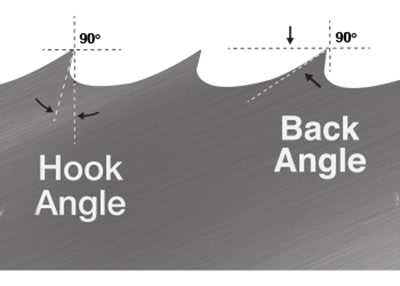
Hook angle is the number of degrees that the tooth face leans forward of 90 degrees.
Back angle is the number of degrees that the backside of the tooth leans backward of 90 degrees.
The hook angle and back angle of a sawmill blade should be chosen based on the type of wood you are sawing and what type of equipment you are sawing with.
- 10/30 Sawmill Blades – Most popular and versatile all-purpose hook angle with a 30° back angle for sawing softwoods, medium hardwoods, and hardwoods including birch, beech, red oak, cherry, walnut, soft maple, pine and poplar.
- 7/47 Sawmill Blades – Only available from Wood-Mizer, this profile is compatible with all horsepower levels and features a deeper capacity gullet for increased sawdust removal, extreme 47° back angle for faster sawing speeds, and sharp penetrating points for increased sawing accuracy.